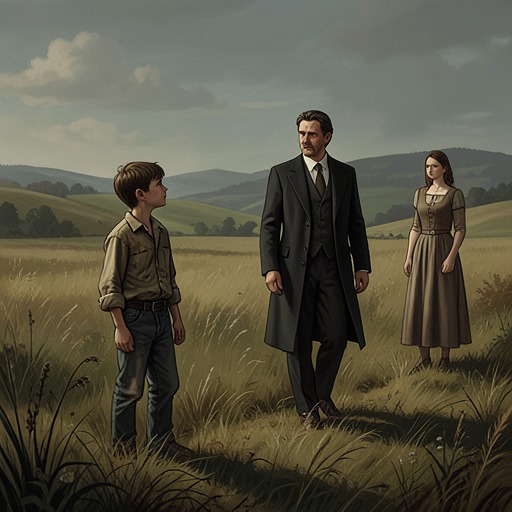
Hindley drops Hareton from the banister
Wuthering HeightsIn the turbulent household of Wuthering Heights, few moments condense the novel's savage energies as sharply as the night Hindley Earnshaw, in a drunken rage, lifts his infant son Hareton over the banister and lets him fall. The incident, narrated by Ellen Dean, unfolds as a grotesque collision of paternal cruelty, accidental salvation, and thwarted vengeance. It is a scene in which the child's life hangs by a thread, and the man who saves him is the very one who has the most reason to wish him dead.
The Drunken Father and the Threatened Child
The episode occurs during a period of Hindley's steep decline into dissipation following the death of his wife, Frances Earnshaw. His alcoholism has made him violent and unpredictable, and his treatment of his own son has become monstrous. Earlier in the same sequence of events, Hindley has already demonstrated his cruelty toward the child, threatening to crop Hareton's ears like a dog's, declaring that he loves something fierce, and even vowing to break the brat's neck. When Ellen Dean attempts to intervene, Hindley seizes the squalling, kicking child and carries him upstairs, lifting him over the banister in a fit of drunken fury. The boy, terrified, redoubles his yells, and Ellen cries out that Hindley will frighten the child into fits.
The Fall and the Catch
As Hindley leans forward on the rails to listen to a noise below, he almost forgets what he holds in his hands. Ellen, recognizing Heathcliff's step approaching the stairs'-foot, leans forward to signal him not to come further. In that instant, her eye quits Hareton, and the child gives a sudden spring, delivering himself from his father's careless grasp, and falls. There is scarcely time for a thrill of horror before the little wretch is safe: Heathcliff arrives underneath at the critical moment and, by a natural impulse, arrests the child's descent, setting him on his feet. The rescue is instantaneous and almost involuntary, a reflex of the body rather than a decision of the will.
Heathcliff's Thwarted Revenge
Heathcliff's expression on beholding Hindley above him is one of the intensest anguish—the blank countenance of a miser who has parted with a lucky lottery ticket for five shillings and finds the next day he has lost five thousand pounds in the bargain. He has, without meaning to, made himself the instrument of thwarting his own revenge. Had it been dark, Ellen reflects, Heathcliff would likely have tried to remedy the mistake by smashing Hareton's skull on the steps. But the salvation is witnessed, and Ellen is presently below with her precious charge pressed to her heart. Hindley descends more leisurely, sobered and abashed, and blames Ellen for the accident, insisting she should have kept the child out of sight and taken him from him.
The Child's Fate and the Legacy of the Fall
The fall from the banister is a defining moment in Hareton's early life, foreshadowing the degradation that will mark his childhood. Though he survives, he is reduced, in the years that follow, to a state of complete dependence on his father's inveterate enemy. When Hindley dies in debt, the whole property is mortgaged, and Heathcliff, as the mortgagee, becomes the master of Wuthering Heights. Hareton, who should now be the first gentleman in the neighbourhood, lives in his own house as a servant, deprived of the advantage of wages, quite unable to right himself because of his friendlessness and his ignorance that he has been wronged. The child who was nearly killed by his father is thus, by a different kind of violence, stripped of his inheritance and his station.
The Animal Imagery and Hareton's Degradation
The scene of Hareton's fall is embedded in a web of animal imagery that defines his character throughout the novel. As a child, he is described as a ruffianly child, strong in limb and dirty in garb, with a look of Catherine in his eyes and about his mouth. Later, Catherine Linton (younger) compares him to a dog or a cart-horse, observing that he does his work, eats his food, and sleeps eternally, and wondering what a blank, dreary mind he must have. The dehumanization that begins with his father's drunken cruelty and Heathcliff's contempt is completed by his cousin's condescension. Yet the same animal vitality that makes him seem brutish also marks his capacity for survival and, eventually, for redemption.
The Fall as a Turning Point in the Feud
The banister incident sharpens the enmity between Heathcliff and Hindley into something almost cosmic. Heathcliff's anguish at having saved the child is not merely personal frustration; it is the anguish of a man whose entire project of revenge has been momentarily derailed by his own instinct. The scene reveals the depth of Heathcliff's monomania—his single-minded devotion to destroying the Earnshaw line—while also exposing the involuntary humanity that undermines it. In saving Hareton, Heathcliff preserves the very instrument of his future triumph and, unknowingly, the agent of his eventual undoing. The child he catches will grow up in his house, degraded and dependent, but will ultimately find love and restoration with Catherine Linton (younger), undoing much of what Heathcliff has built. The fall from the banister is thus a moment of profound irony: the man who lives by revenge is forced, by his own nature, to preserve the life that will help bring about his end.